Carpool Duty as a Counselor

Screen Shot 2015-12-09 at 8.38.39 PM

As school counselors, sometimes we are asked {or told} to do things that are outside of our roles as counselors, such as coordinating standardized tests and monitoring the cafeteria at lunch time. I am SO grateful that 90% of what I do is actually related to counseling, but I still have a few tasks in that remaining 10% that should not be a job of the school counselor, and one of those tasks is carpool duty.

All faculty members have some sort of dismissal duty at my school. Most have a line of students they check off of their lists and dismiss. Some are “sweepers” who make sure the halls are cleared at the end of the day. A select few of us get to do carpool duty EVERY SINGLE AFTERNOON {hooray?}. At first I hated carpool duty. It’s not as much of a dual role as substitute teaching a class, but in my head, I grouped it with having recess or lunch duty – not roles school counselors should take on. Having this duty also means that I can’t schedule any parent meetings immediately after school, which is simply an inconvenience, but nothing horrible.

How I changed my mindset about carpool duty:

Even though it can be an annoyance sometimes, I’ve come to love carpool duty because I can use that time to connect with my students and check in with parents. The way carpool works at my school is that each teacher {or counselor in my case} has a station. As the kids’ names are called, they go to a designated faculty member who puts them in the cars. Basically, it’s a lot like lining up for Disney World rides. Normally there is at least time to quickly check in with a student before the car pulls up, so I try to connect with every student who is assigned to me before opening the car door. Sometimes, it’s as simple as asking how their day has been, but just by sparking that conversation, it typically opens the door for students to ask to make an appointment with me or to share good news, bad news, and anything in between. I’ve also had parents ask me questions, request meetings, and tell me significant life events in that short span of time between me helping the child in the car and them driving off. Carpool duty gives me another opportunity to be visible on campus.


I am a strong believer that a school counselor needs to be visible in a school. I know there are times we just want to stay in our offices and catch up on paperwork in those rare instances we’re not seeing a student or meeting with a parent. Trust me, I understand that feeling. As difficult as it may be to find that motivation to do a walk-through of the school or to go outside during recess, I’ve found those little things make a big difference. I always see a surge in students asking to see me immediately after presenting my monthly lesson in their classroom. Why? Because they are reminded that I am there. Sometimes students who wouldn’t typically seek me out {but who have a lot of difficulties in their little lives} are brave enough to ask to talk to me if they just happen to see me in the hallway, at recess, or at carpool duty.


Be a presence in your school! Being a school counselor is such an amazing opportunity to help children, and I’ve found that by changing the way I approach carpool duty, I’ve had the opportunity to change even more lives.

*gets off soapbox*
Reading Together: A Parent Volunteer Program

Screen Shot 2015-12-08 at 4.03.29 PM

Prior to having a full-time counselor at my current school, there was a program in place called CARE Club (Choices Are Rarely Easy). Through this program, parent volunteers visited the K-4th classrooms once a month to present a lesson or read a book on various topics dealing with social skills {Hmm…that’s sounds a lot like what a school counselor does, right?}. The main reason this program existed is because until I came aboard, there was no full-time counselor to deliver these lessons, and it was a way for parents to volunteer in the classroom.

While I’m grateful for this program because it allowed the children to get a precursor to my monthly lessons, the system was pretty broken when I stepped into it. There was no one monitoring whether or not every class had a volunteer each month, which led to a lot of inconsistency in implementation. Also, parents were offered resource binders from 2006 with lesson ideas but were not given much guidance past that {these binders were accompanied by VHS tapes}. To me, if I were a parent with no teaching or counseling experience, I would be pretty intimidated to deliver a lesson like that to a classroom of children.

I discussed the program with my principal, and while she agreed that monthly social skills lessons were no longer needed from the parents because I was presenting them in a counseling capacity, she felt strongly that we have a parent volunteer program in place in our lower school. Because of this, I created my brain-child project called Reading Together as a way to keep our parent volunteers and use them in effective and consistent ways.

The program is divided into two groups with similar goals:

  • Kindergarten classes
  • 1st -4th grade classes


Kindergarten Program

For both groups, parent volunteers come into each K-4th class to read to the children. In Kindergarten, volunteers come once a quarter, and they read a book and facilitate an activity based on my most recent lesson in the classroom. For example, my 1st quarter lesson for Kindergarten this year was tattling vs. reporting {see lesson here}, and the parent volunteer that quarter read the book A Bad Case of Tattle Tongue and led the class through a corresponding worksheet. This allows the parents to reinforce and build upon the lessons I present to the Kindergarten classes.

FullSizeRender 8


1st – 4th Grade Program

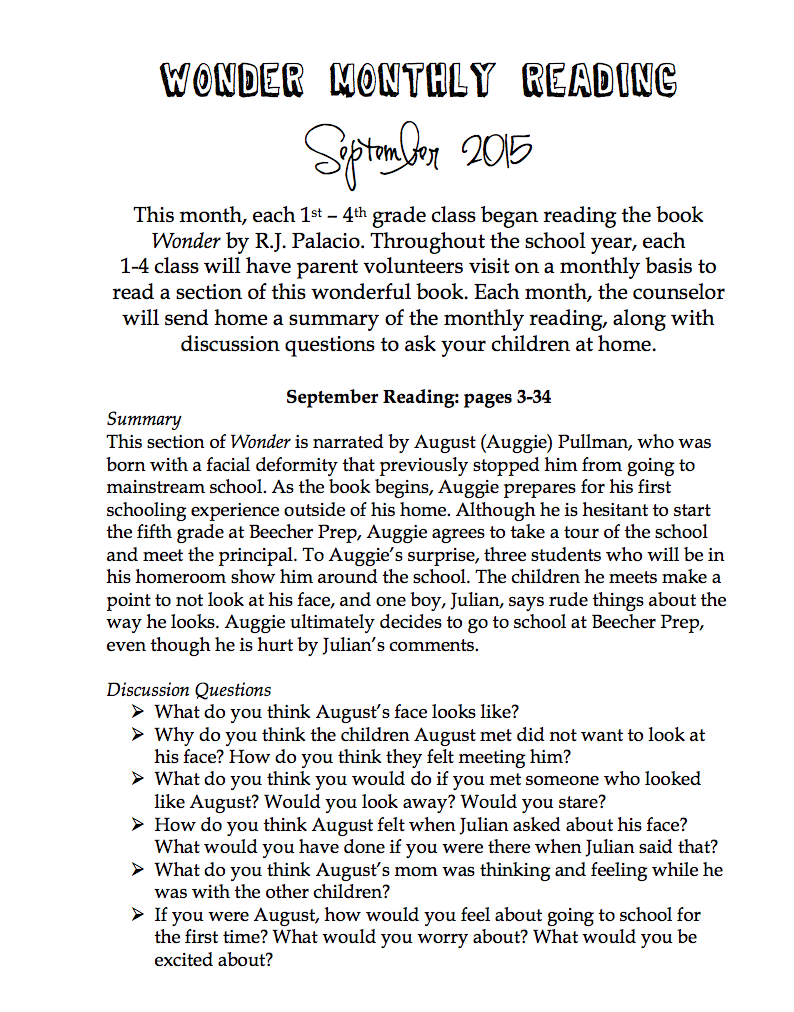
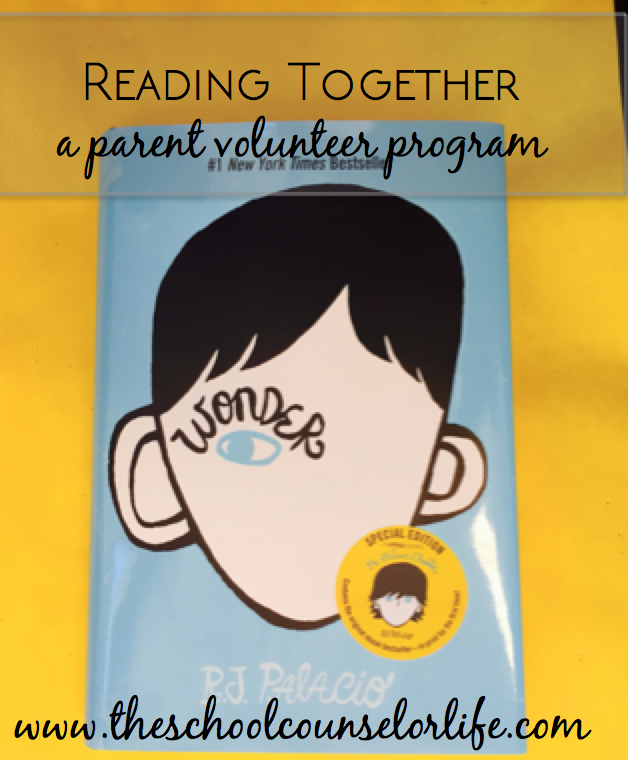
This program focuses on one book for the entire school year, with sections of the book read by parent volunteers once a month. The first reading took place in the month of September, and by May the entire book will have been read to each class. This year’s book choice is Wonder by R. J. Palacio, which is such a fantastic tool to promote empathy among children.

FullSizeRender 7

Every school year, I will ask teachers for input on the book choice for the following year. Each book read through this program will focus on a strong moral issue so that it can be integrated into my monthly lessons.

For the book Wonder, I created handouts for the volunteers with a summary of the previously read section, a summary of their section, and possible discussion questions for them to ask the students. I also send home handouts to all 1st-4th grade parents detailing what was read that month and providing them with discussion points to reinforce the book at home {see sample page below}. If you ‘like’ The School Counselor Life on Facebook and e-mail theschoolcounselorlife@gmail.com requesting the full version of my handouts and volunteer packets, I will be more than happy to send them to you.

Screen Shot 2015-12-08 at 4.11.49 PM


So far, this program has been successful, but there are a few things I will change for next year {this year, I’m still working out the kinks}.

  • Next year, I will do the same program I implement with Kindergarten with 1st Although some 1st graders are connecting to the story, it takes those classes much longer to get through each section of the book because so much has to be explained.
  • I will pick a shorter book next year. I knew when I chose Wonder that it was an ambitious pick because of its length, but the story was so wonderful that I couldn’t pass it up. Next year’s book will be shorter so classes have more time left for discussion.

Comment below with any parent volunteer programs you’ve implemented at your school!

Screen Shot 2015-10-12 at 8.12.23 PM


A 2nd Grade Lesson on Working Together

Screen Shot 2015-11-29 at 10.38.46 AM

No matter how old we get, there is always a chance that we will have to work with or be around someone that we just don’t like very much. Even as an adult, that can be difficult to navigate. That’s why I make sure to implement classroom lessons on group work and working well with others beginning in 2nd grade, so that children can start to learn at a young age how to handle a situation they are likely to face in middle school, high school, college, and in the workforce: dealing with people they dislike.

Today I will share a lesson I created for my 2nd grade students to introduce the concept of working together. I will also be posting links to some of my favorite group work lessons from other blogs that I use with my middle school students!


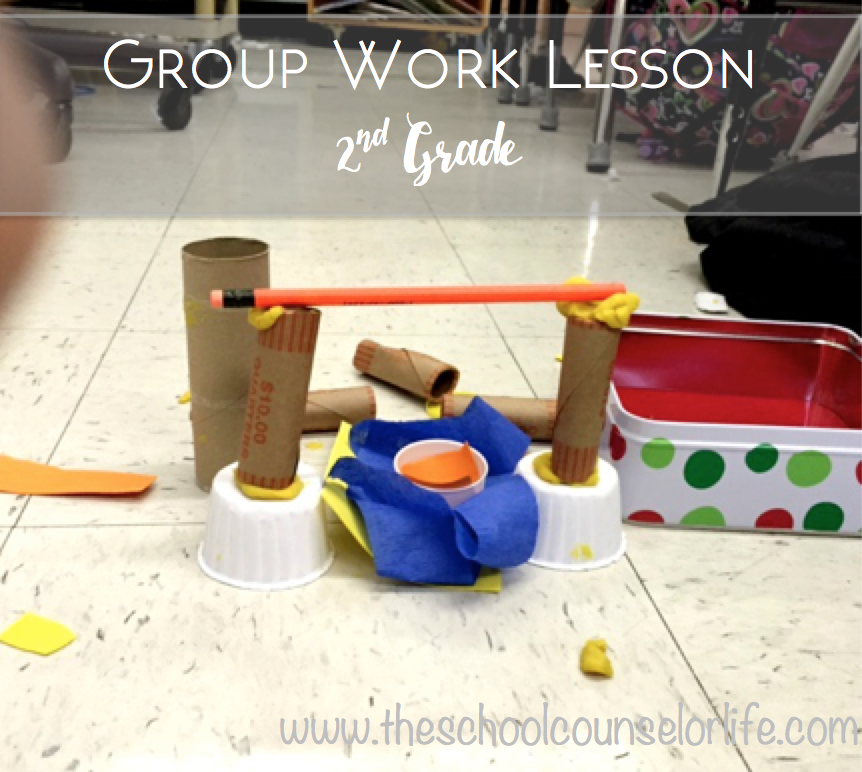
I begin my group work activity by dividing the students into groups. For this lesson, I make the groups uneven, so one group may only have 2 members and another may have 8. Each group is given a container of extremely random supplies, such as play-doh, empty quarter rolls, foam pages, streamers, and toilet paper rolls. The groups all have 15 minutes to create anything with their supplies, but they must use EVERYTHING in the container or they are disqualified. After explaining the rules, I set the timer and let them work.

IMG_3249

When time is up, we process the activity as a class. I ask the students about the different group sizes and how that impacted their ability to work together {i.e. small groups had less ideas they had to choose from, but large groups had more people to actually put together their creations}, and we relate this back to both school projects and groups of friends. I also ask students what they think their group did well and what their group needed to work on. It seemed that most of the issues stemmed from the way the students were communicating with each other {go figure}, so we also review good communication skills. To wrap up the discussion, we talk about how to work in a group when there is a group member that they don’t get along with, and how to be nice to someone they don’t like {even outside of group work}.

I was extremely proud of my 2nd graders for being so thoughtful in our discussion. They really did a great job connecting the meaning to the activity.

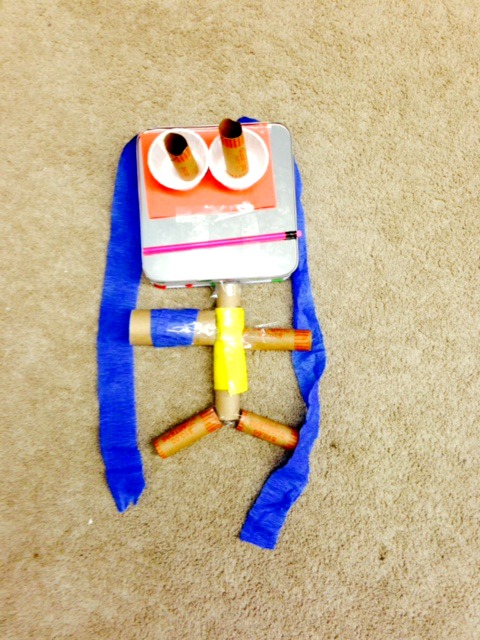
To make it extra fun, I told the students that I would be showing all of the middle school teachers photos of the creations and that they would vote on their favorites. The winning team members got certificates, and they were beyond excited. Check out some of my favorites below:


IMG_3225 IMG_32232


Here are a few other other group work/team work lessons that I implement with my students in the middle grades:

The Marshmallow Challenge from Exploring School Counseling

Saving Sam from All for the Love of Teaching

The Cup Stack Challenge from Ms. Sepp’s Counselor Corner


Screen Shot 2015-10-12 at 8.12.23 PM

How I Organize My Bookshelves


Screen Shot 2015-11-08 at 1.44.54 PM

There are many aspects of a counselor’s job that cannot be organized, planned for, or perfectly laid out because we are constantly responding to our {often} unpredictable clients and/or principals. That is why I plan ahead for anything I can — such as my classroom lessons — and organize as much as I can to make those unpredictable moments or days a little easier.

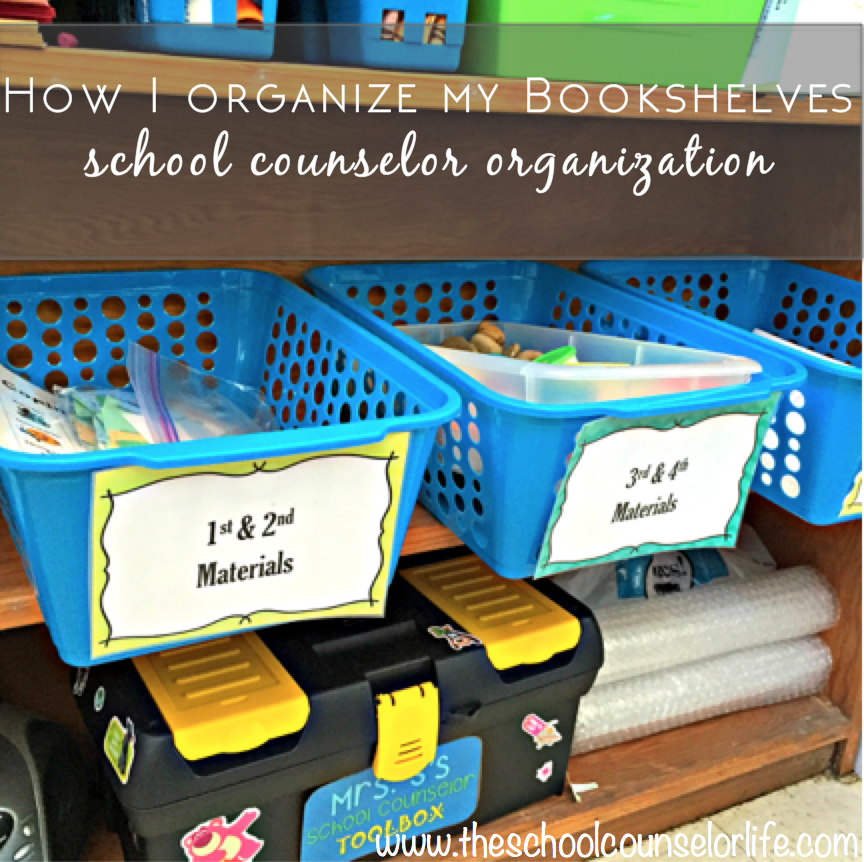
I am fortunate to have a lot of shelf space in my office, but even if you don’t, I firmly believe you can still use many of my organization ideas with a little creativity and many dollar store containers. As you can see in the pictures below, I have designated spaces for books, art supplies, and classroom lesson materials.


IMG_5198

IMG_5200

Classroom Lesson Materials

My first year as a school counselor, I did not have any space designated for all of my classroom lesson materials, which basically means that my office was a hot mess. As I accumulated more and more things, I decided to sort through the clutter and develop a system.

I keep all of the materials that I’m not currently using in bins and pouches purchased from the dollar store, and I made labels for most items, such as the bingo cards pictured below.

FullSizeRender 2

FullSizeRender 3

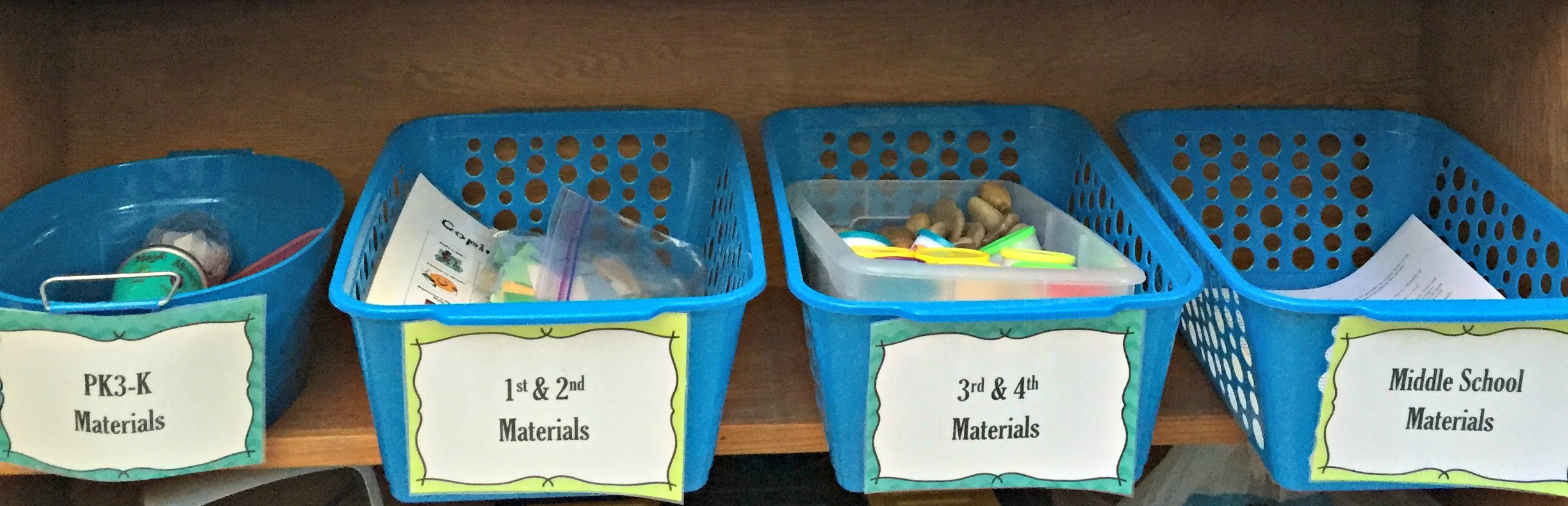
I have labeled bins for all of the lesson materials I am currently using with classes, which are organized by grade level. Since I don’t have all classes from one grade on the same day, this saves me time I used to spend putting away and searching for materials multiple times every month. Once I’ve seen every class in a grade level, I simply clear the bin and immediately fill it with what I need for next month’s lesson.

IMG_51982


Art Supplies

I think it’s important for school counselors to have basic art supplies on hand. Whether you’re directly using play therapy techniques or not, students’ creations tell us a lot about their lives, and the act of drawing or coloring can also provide children with something to do while talking, which often allows them to talk more openly. I always make sure I have construction paper, markers, colored pencils, crayons, scissors, and glue in my office, and the art bins I purchased from the dollar store are perfect for holding most of these supplies {see below}.

FullSizeRender 4                FullSizeRender 5


Books

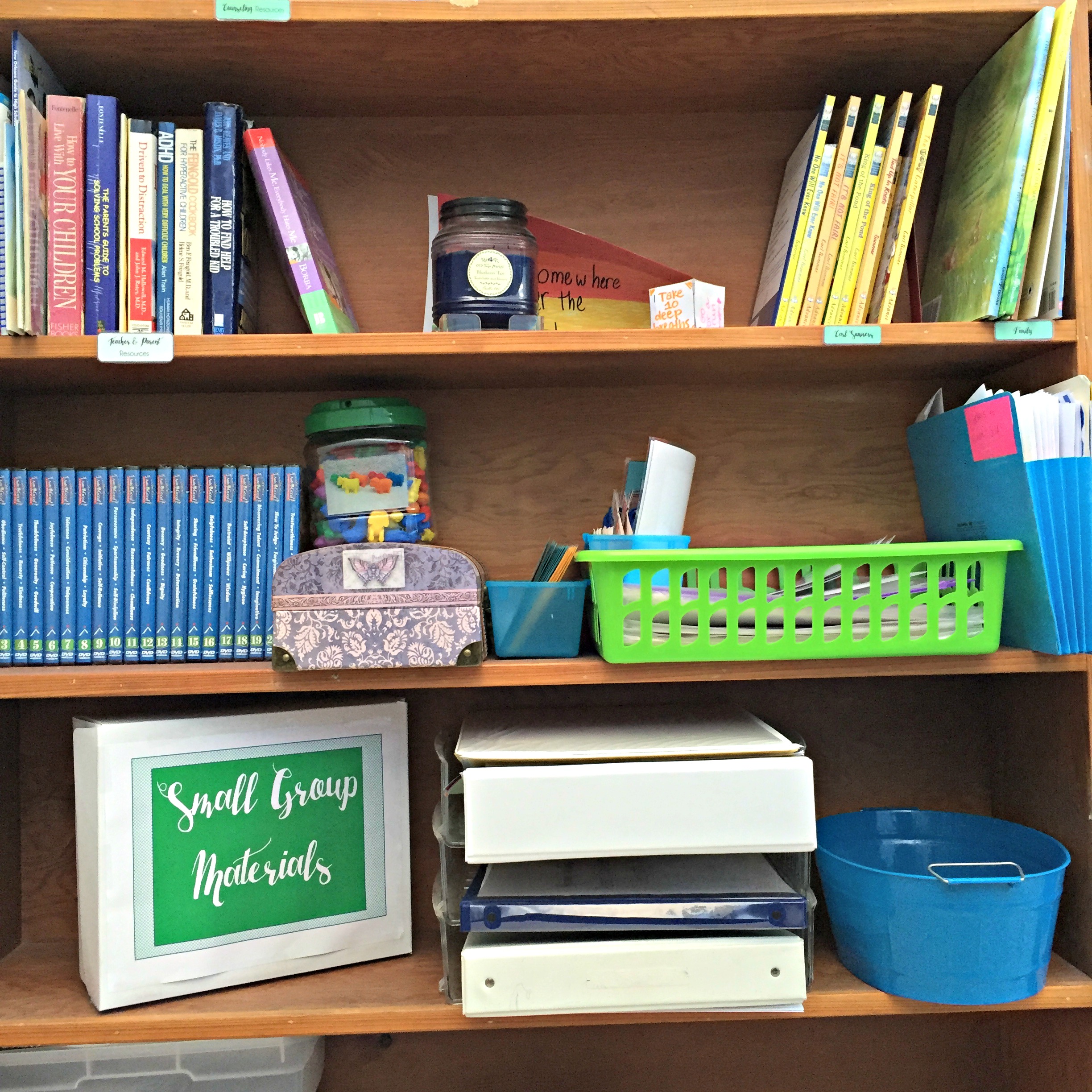
First off, let me say that I love books, and I love using bibliotherapy in my sessions. Much to my delight, when I first inherited the office at my current school, the previous counselor had left behind many books that were purchased by the school. I was so excited to have a collection of books readily available to use with students, however, they were not organized in any particular order, many of them were piled on top of others, and the bookshelf was in complete disarray. One of the first things I did before the start of the school year was group all of my books by category, use bookends to organize the shelves, label the shelves, and catalog each book by type so I know what resources I currently have in my office.

IMG_5201

I used the following categories to label my bookshelves: Grief & Loss, Behavior, Self-Awareness & Self-Esteem, Manners, Feelings, Friendship, Bullying, Family, Teacher & Parent Resources, Counseling Resources, Religious Resources, and Miscellaneous.

Download my bookshelf labels for FREE on my TpT Store!

Screen Shot 2015-11-20 at 4.47.09 PM

To catalog my books, I use Library Thing, which allows users to add books by ISBN number or by searching for a title. I separated my catalog into the same categories listed above, and I continue to update my list whenever I add a book to my collection. Something that makes Library Thing such a good resource is that it is based online, which means I can access my book list from anywhere. If I’m planning lessons over the summer, I can pull up my catalog and know whether or not I have a book I need, and if I’m answering parent e-mails at home, I have a list of resources I can draw from if needed.


Well, that’s how I organize my bookshelf! Feel free to comment with any of your unique organization techniques as well!


Screen Shot 2015-10-12 at 8.12.23 PM

Families in Transition (FIT) Small Groups

Screen Shot 2015-11-02 at 7.08.20 PM

Another small group I offer in addition to Lunch Bunch is my Families in Transition (FIT) group. FIT groups are for students who are facing or have faced transitions in their home lives, such as divorce/separation, an absent or incarcerated parent, death of a family member, or moving. I started running these groups last year with 5th and 6th grade students, and this year I will be offering them to 3rd and 4th grade students as well.

So, let’s go through all of the fun elements of a small group proposal, shall we?

Rationale

This is the rationale I gave my principal when proposing FIT groups last year:

“FIT Groups are designed to ease students through transitions they are experiencing in their home lives, such as divorce/separation, an absent or incarcerated parent, death of a family member, and moving. Often, children feel as if they are the only ones experiencing family changes, and this small group will allow students to realize they are not alone in navigating these issues. FIT Groups will provide a safe environment in which students can talk about their struggles, gain and offer support, and use problem solving skills.”

Recruitment

I sent home letters describing FIT groups to all 5th and 6th grade parents. This letter included a form for parents to return to school to express interest in their child being placed in a group. {Click here to view the letter.} Once I received all of the interest forms, students were divided into groups based on various factors, such as grade level, gender, type of transition, and personality, with no more than 6 children in a group. Once the groups were formed, I sent permission forms to the parents detailing their child’s specific group, which had to be signed in order for the child to participate. {Click here to view the permission form.}

Duration/Length/Logistics

Each FIT group met once a week for 6-8 weeks depending on group needs. Groups were scheduled so that students do not miss any core classes or recess, and typically they met during Library or Computer class. All of my small group sessions take place in my office. Thank goodness I have enough space to run groups! {See my Office Tour post for more info.}

Group Objectives

  • To express a sense of universality
  • To form relationships with fellow students
  • To disclose difficulties faced in their transitions
  • To develop coping skills, self-awareness, and empathy

Evaluation

I gave a survey to all participants during the final group session asking about their group experience. {Click here to view the survey}.


FIT Group Activities

The only transition I received responses for was divorce/separation, so the groups I ran last year centered on being a child of divorce. Below are some activities I did within those sessions.

(1) FIT Group Board Game

IMG_5285

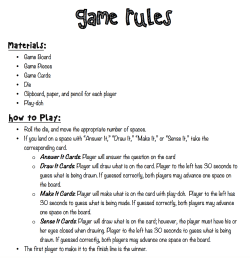
I created a board game for my opening sessions with the 5th and 6th grade students, which allowed them to have fun and bond while I gathered more information about them and their home lives. Here are the materials and rules for the game {click image to enlarge}:

Screen Shot 2015-11-03 at 5.21.09 PM

Using this game {which was a HUGE hit with the kids} was a great way to introduce the group and build rapport. We also spent some time developing group rules, talking about each student’s family situation, and discussing the students’ expectations for the group.

The game board and question cards are for sale in my TpT Store. {Click here to download}

(2) Draw a Family

IMG_5288

During one of our group sessions, I had each participant draw a family {specifying it could be any family, and it didn’t have to be theirs}. Most of the group members drew a mom, a dad, and one or two children. Once they were done, I had them draw THEIR family on the same page, and then we processed the activity.

I noticed when we were discussing the drawings that I kept hearing variations of the following: “This is a normal family. They have a mom, a dad, a little boy, and a cat. This is my family. I have a dad who lives over here and a mom who lives over there.” What really struck me was the constant use of the word NORMAL to describe the other families they drew that weren’t their own. We used the activity to normalize what they have been experiencing and to increase a sense of universality among group members. I think this was a great opportunity to redefine their traditional views of what a family is supposed to be and to help them move beyond the normal/not normal concern.

(3) Family Comic Strip

Screen Shot 2015-11-08 at 1.07.30 PM

The groups I had last year were very artistic and LOVED to draw, so I incorporated a lot of art into our sessions. For this activity, each child received a page with empty comic strips. The only guidelines given were that they had to draw a comic of what their families are like at home. Even though this was not an instruction, every child drew a comic of life at one parent’s house on the top strip provided and life at the other parent’s house on the bottom strip {see above photo}. This gave me a lot of information about their home lives, and I was able to see just how much inconsistency these children were experiencing when they left school {which was A LOT}.

I used this activity to lead into a discussion on the difficulties of switching between houses, including what it is like to have 2 rooms, 2 sets of personal items, and {often} 2 completely different sets of rules.


Overall, I greatly enjoy running these FIT groups. I think they are beneficial to the students that I serve, and I received good feedback from both children and parents.


Screen Shot 2015-10-12 at 8.12.23 PM

Tattling Versus Reporting – K & 1st Grade Lessons


tattlingreportingheader

“Johnny looked at me funny!”

“Susie isn’t doing her work!”

“George is using my pencil!”

If you have ever set foot in an elementary school, you’ve probably heard kids say things like this. Children tattle for a variety of reasons, but it seems to me that the primary reason for tattling is that they do not know how to solve the problem on their own. I think it’s so important for children to learn problem solving skills so that they can begin to handle smaller situations on their own. Cue my yearly lessons on tattling versus reporting. Below I will share 2 lessons, one I use with my Kindergarten classes and one I use with 1st grade.

Kindergarten Tattling Versus Reporting Lesson

I begin my lesson by asking the class if they can tell me what tattling means. Most of them say things like, “Telling the teacher” or “Getting someone in trouble.” When I ask them the meaning of reporting, I get very similar responses, so we begin to talk about the differences between tattling and reporting.

The main difference we identify is whether we are telling about a “kid-sized” problem or an “adult-sized” problem. When introducing this concept, I tell the students that kid-sized problems are smaller things that kids can learn to solve on their own. Adult-sized problems are more serious and require the help of a grown-up. I have the students give some examples of each. When we tell about a kid-sized problem, it is tattling. When we tell about an adult-sized problem, it is reporting.

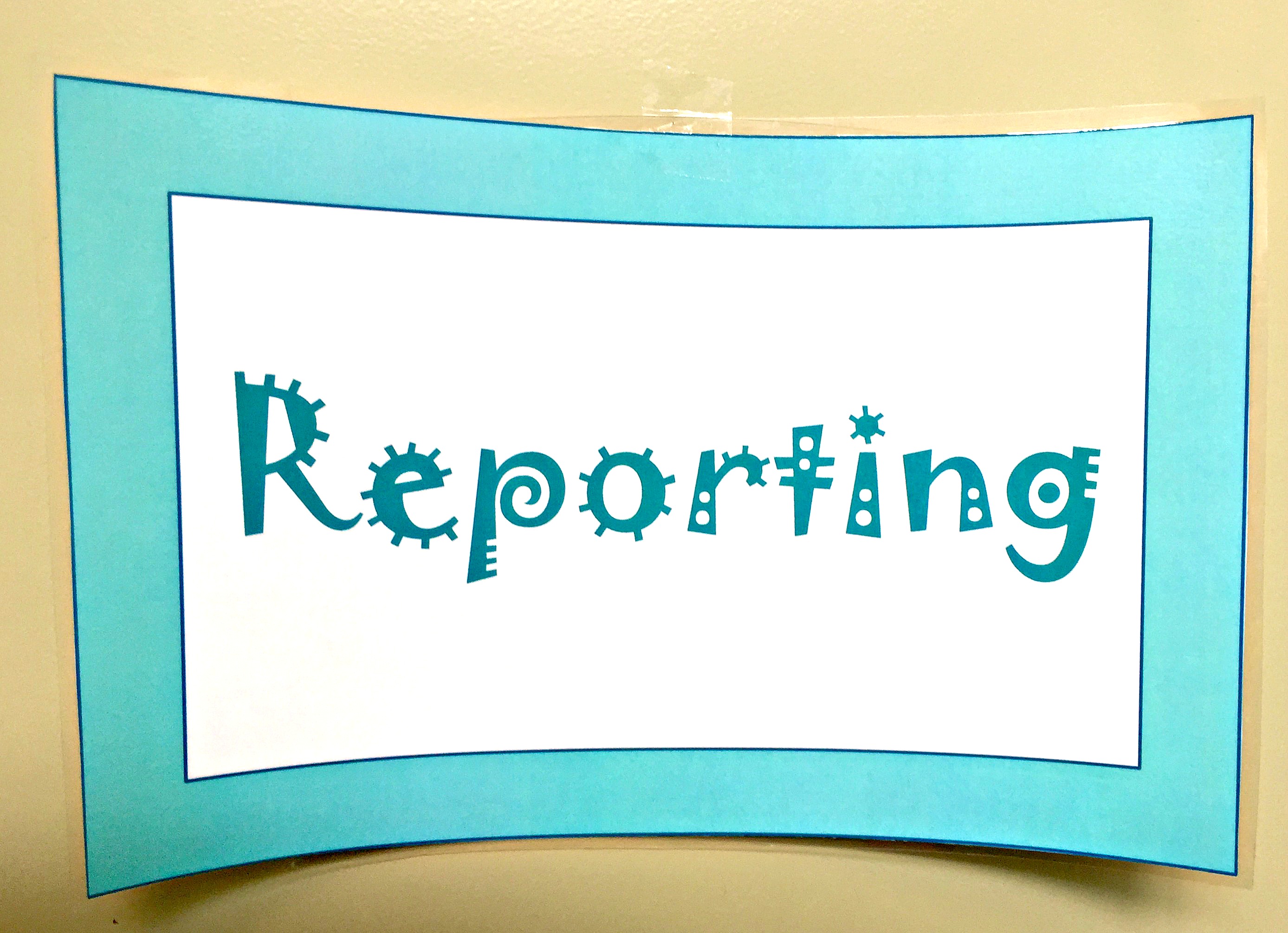
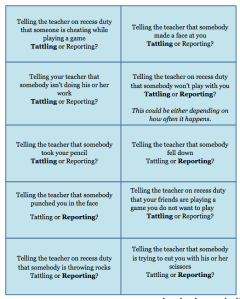
Once we finish talking about tattling and reporting, I start a game to test their knowledge on the subject. I love this activity because it gets them out of their desks and allows them time to move {which is SO important for children!}. On each side of the room, I tape up a sign. One sign says, “Reporting,” and the other says, “Tattling.” I read a situation to the class, and once they decide whether it is tattling or reporting, they walk to the appropriate side of the room {I learned after my first time doing this to emphasize that they should walk as to avoid kids channeling their inner Tasmanian devils}.

FullSizeRender 2edit

FullSizeRender 13

I read the following scenarios to the class {click the image below to enlarge}:

Screen Shot 2015-11-05 at 4.13.53 PM

Once the game is complete, we all sit in a circle and talk about HOW to solve kid-sized problems without tattling to an adult. I have the kids share their own methods of problem solving, and then I add in my own using cards like these that I created:
FullSizeRender 11FullSizeRender 10FullSizeRender 12 ..

We finish out the lesson with a review of the differences between tattling and reporting. The teachers at my school make sure to reinforce these concepts and to use the same language when addressing a tattling situation. It is so rewarding to see how much of this lesson the students remember when I do my next lesson in 1st grade!


1st Grade Tattling Versus Reporting Lesson

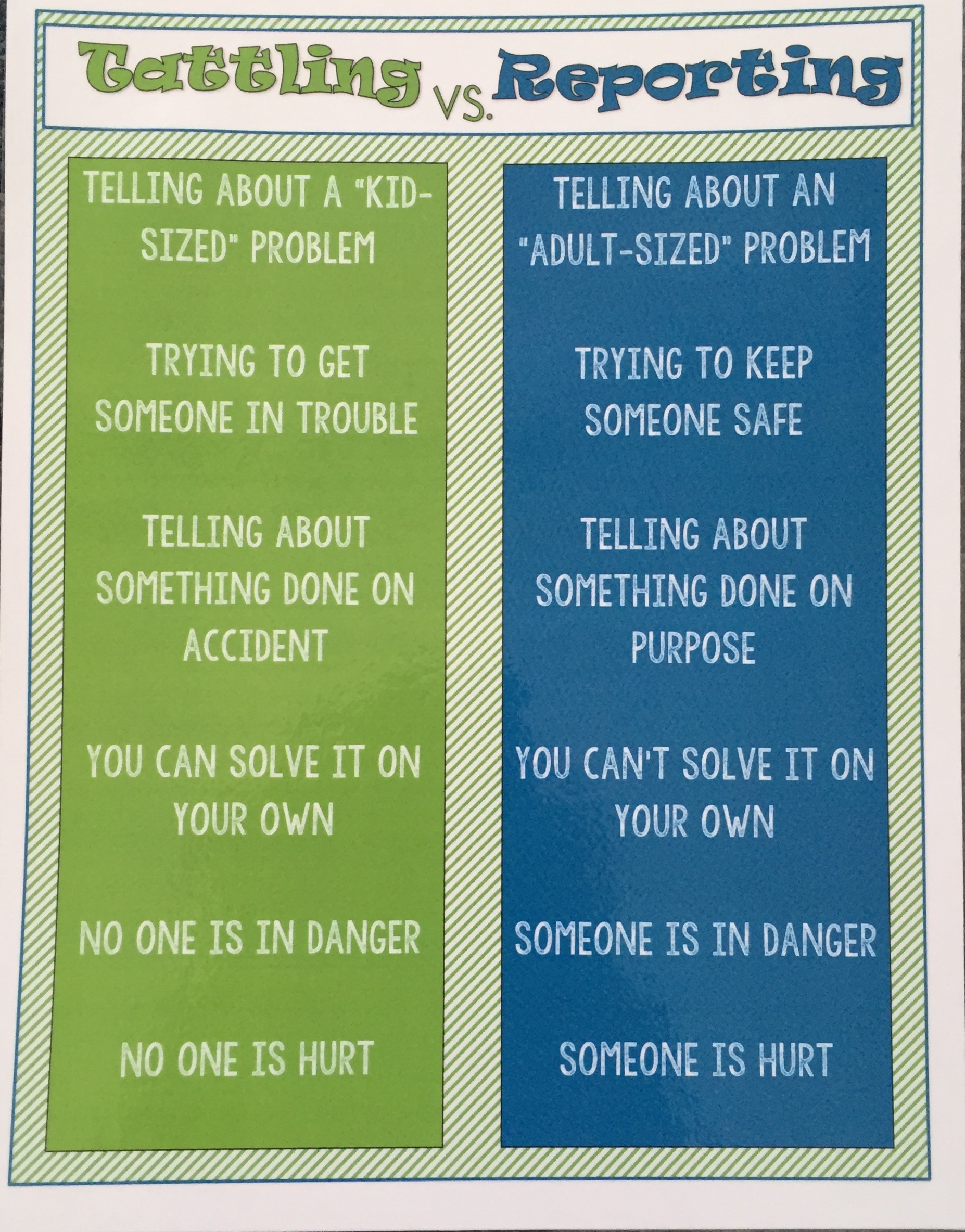
I begin my 1st grade lesson with a review of the concepts presented in Kindergarten, and I am always impressed with how much they remember. During the review, I use a poster that lists the differences between tattling and reporting {the poster can be found here on my TPT Store}.

FullSizeRender 9

We then play a game that is very similar to one I play with the Kindergarteners. I first divide the students into pairs, so that we can work on interpersonal skills while playing the game. Each pair receives two paddles, one that says, “Reporting,” and one that says, “Tattling.” I read situations to the class just like with Kindergarten; however, this time, they must first discuss it with their partners and decide together which paddle to hold up. If the pair cannot agree, they may each hold up a different paddle. During this exercise I also emphasize the importance of sharing, as I make sure everybody has an equal chance to hold up his or her group’s sign.

Screen Shot 2015-10-30 at 3.56.12 PM

Here are the scenarios I use with 1st grade {click the image below to enlarge}:

Screen Shot 2015-11-05 at 4.14.24 PM

When the game is over, we talk again about how to solve kid-sized problems. In 1st grade, I use a poster based on Kelso’s Choice Conflict Management Skills Program. {Get the poster here on my TPT store}

FullSizeRender 5

After discussing each possible choice, I ask the students to try at least 2 of the solutions on the poster before telling a teacher. I leave the posters with each class, and the teachers typically hang them by their desks where they can easily be seen {which they simply direct a student to if he/she is tattling}.

These lessons have been a great tool for my school to minimize tattling and increase problem solving skills. I hope they help you, too!

Screen Shot 2015-10-12 at 8.12.23 PM

Coping Skills Cube Lesson

As the students at my school approach exam time, I’m noticing stress levels begin to SOAR, and, let’s face it, with a full 6 weeks until our next break {for Thanksgiving}, my stress levels are soaring as well. This is the time of year I love to teach the kids about stress management and coping skills, because they can apply the lessons to real life right away {which means I’m actually teaching them something relevant to their world! Yes!}

In this post, I’m going to share one of my favorite lessons for coping with stress – one I typically do with my 4th graders. Soon I will also post a lesson I do with my 5th graders on the same topic : ) Enjoy!


Coping Skills Cube – 4th Grade Lesson

CopingCubewithLabel

I begin my lesson with a review of what coping skills are and types of things we experience that require coping skills – all things they’ve already learned. With my 4th graders, I introduce the difference between healthy and unhealthy coping skills for the first time, which always produces interesting discussions {Student: “Punching my brother makes me feel SO much better!” Me: “Class, do you all think Johnny’s coping skill is healthy or unhealthy?” lol}

After discussing the topic at hand, I show the class my coping cube {see above photo}.

I share my favorite coping skills with the group and then explain that they will get to make a cube with their favorites as well. Using the cube template {included at the bottom of this post}, I have the students write one thing on each square  they can do to make themselves feel better when they are angry, sad, or upset. Students then decorate the numbered squares {on the back side of the template}, cut out the template on the solid lines, and proceed to assemble their cube.

copingcubetemplate

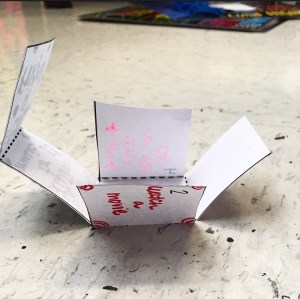
To put the cube together, students will fold the template wherever there is a dotted line {with the numbered coping skill squares on the outside} until it begins to form a cube shape.

CopingCubfold

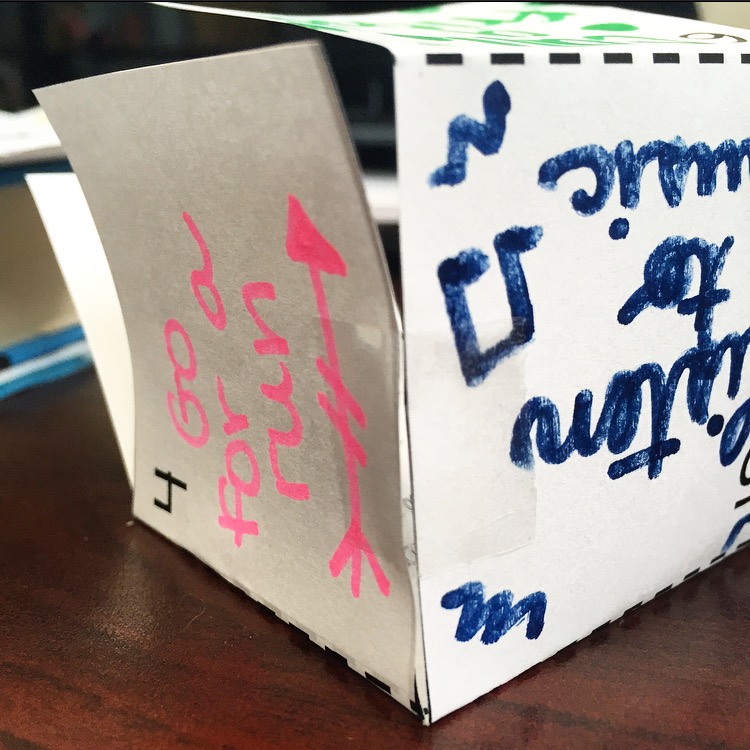
To hold it in place, tape the edges of the cube, and voila! I’ve found that the assembly part goes a little smoother if I help them put the tape on first and then assign a couple helpers who have seen me do it a few times to assist their classmates {this also keeps the ones who finish early from being disruptive}.

copingcubetape

We finish out the lesson with a discussion of why having something like a cube with our coping skills on it may be helpful. The students always seem to pick up on the idea that when we are angry or sad it is hard to think of things that will make us happy or content again, so if they can toss a cube and instantaneously have something to do, it can make the coping process much easier.

{Get my FREE cube template printable here}

Screen Shot 2015-10-12 at 8.12.23 PM

Lunch Bunch Overview


Screen Shot 2015-10-24 at 3.44.38 PM

If you’re a school counselor and you’ve been on Pinterest, then I’m sure you’ve heard about the Lunch Bunch craze sweeping our schools. Last year, I jumped on the Lunch Bunch bandwagon, and I’ve found this small group to be SO beneficial for the 5th grade girls to whom I offer it.

Since I already see every Middle School student in a small group {I’ll post more on this later}, I decided to limit Lunch Bunch to the 5th grade girls at my school. The transition of beginning Middle School coupled with the intense drama that seems to appear in this grade, Lunch Bunch in my school best serves these girls.

I hold one Lunch Bunch group every Wednesday during our recess and lunch time {spanning about 40 minutes}. Every month, I post a sign up sheet outside my office with 7-8 available spaces per week. Each girl may sign up for one slot during the month, and this program is completely voluntary {although I never have blank spaces on my sign up sheets, which is amazing}.

lunchbunchsignup

The day before a Lunch Bunch group, I pass out a slip to each girl reminding her to bring her lunch to school the next day. I personalize each reminder slip by decoratively writing the girls’ names on them, which they love {see above photo}.

Since I only have enough space for each girl to come once a month, I choose a different activity/topic every month {which is much easier than trying to develop a new session every week}. We begin each Lunch Bunch session with a check in, where each girl says a POW {something bad/not great that happened that day}, a WOW {something good/exciting that happened that day}, and what she brought for lunch. I typically dedicate the first 15-20 to discussing anything relevant to what’s going on in their lives that week while the students eat their lunches, then the rest of the time is used for activities, games, and targeted discussions.

The students truly love this small group, and it is a great opportunity for me to continue to build rapport with these girls.


Stay tuned for some of my favorite Lunch Bunch activities I’ve created or borrowed! I’ll be posting them soon on the blog.


Screen Shot 2015-10-12 at 8.12.23 PM

My Office Tour

Screen Shot 2015-10-24 at 3.56.17 PM

The day I accepted the counselor position at my current school, I was brought to my soon-to-be office to meet with the previous counselor. Based on other schools I’ve worked in and visited, I wasn’t expecting much – just enough room for a couple of chairs and a desk – but much to my surprise, I was led to an office with enough space to not only have individual sessions, but to hold my small group sessions as well! {See below}

IMG_1975

The amount of space I was given was an amazing thing, but it was also a lot of space to decorate, which was a little intimidating. As you’ve probably noticed from my other posts, I have a severe Pinterest addiction, so of course I sifted though pins and pins of office ideas. I adopted a few things I saw and created plenty of my own, so I thought I would give you all a tour of my office to hopefully inspire you as you create a safe, warm, and welcoming space for the students at your school.

THE DOOR

door


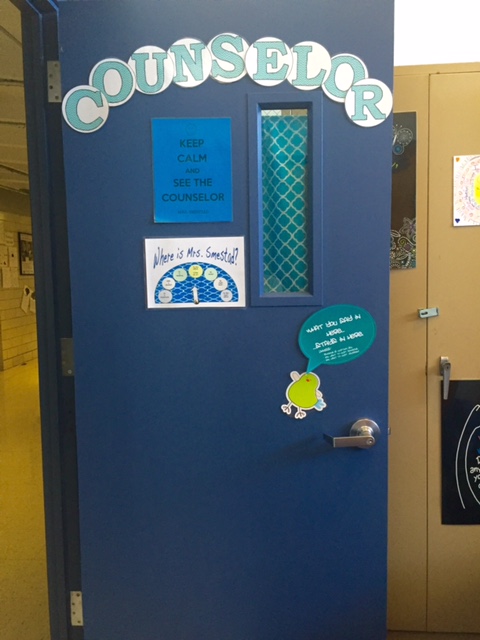
My door has quite a few decorations, which I think makes my office more approachable. I used this free printable to create the word “Counselor” at the top of my door and I downloaded the ‘Keep Calm’ font to make the “Keep Calm and See the School Counselor” sign.

FullSizeRender 12

As many of you have probably seen on other blogs, I created my own “Where is the Counselor?” sign using Word, so that the students can find me easily. The kids have told me over and over how much they like being able to know where I am at all times {sometimes I wonder if it’s a good thing or a bad thing lol}.

WhereisSign


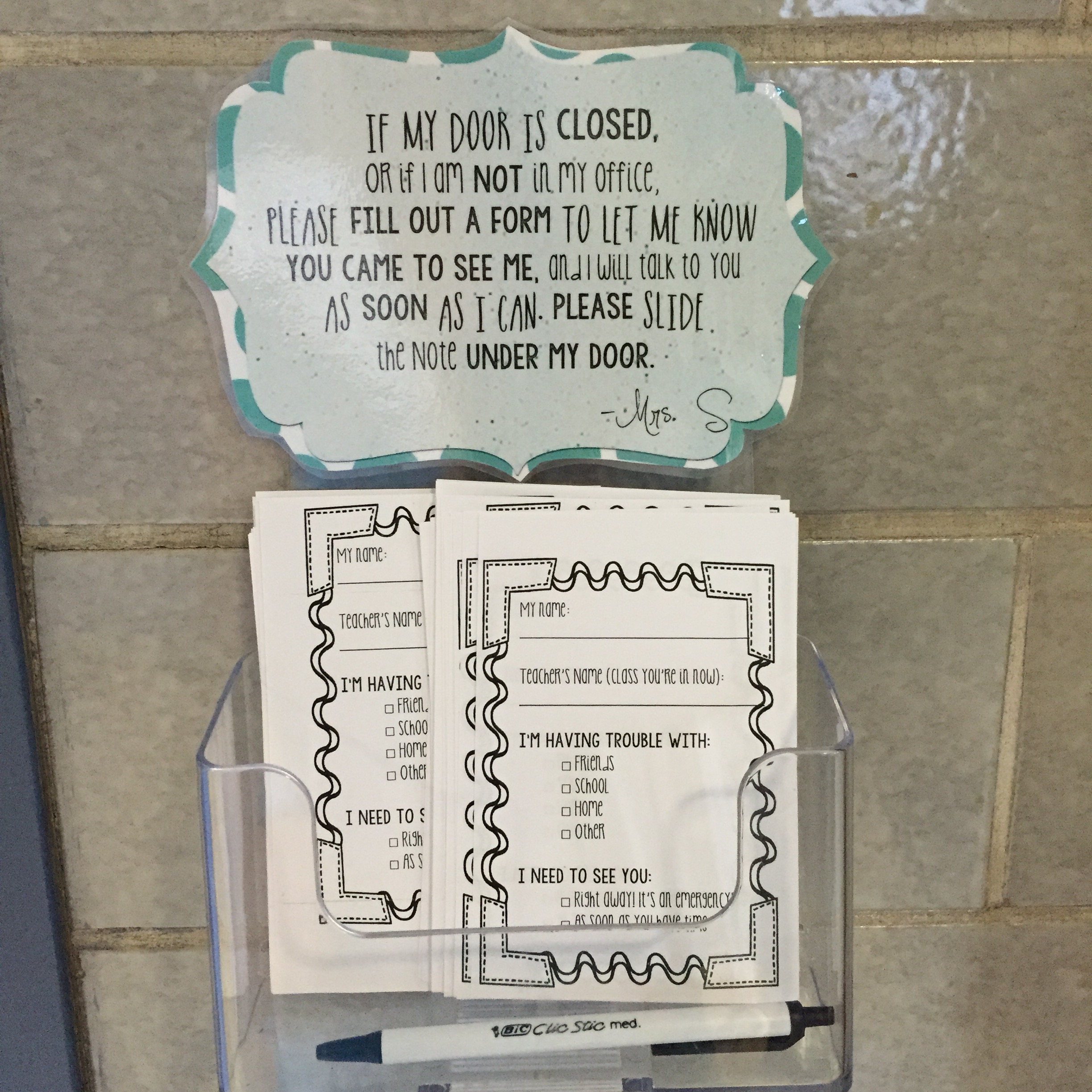
On the wall next to my door, I have a box with student referral slips. I created the sign in Word using  this free frame from The 3am Teacher and the following free fonts: Supernova, All of Me, and Skinny Latte.

IMG_4686

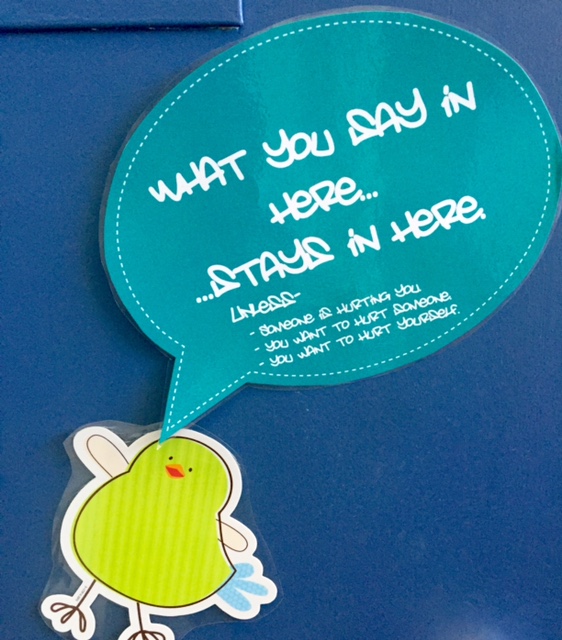
Finally, I included the exceptions to confidentiality on my door, paired with a cute bird cutout from the Educator store. I honestly can’t remember if I made the confidentiality sign myself in Word or if I found in on Pinterest {oops!}.

Confidentiality


MAIN COUNSELING AREA

The main space of my office is where I conduct individual and small group sessions. I have 11 bean bag chairs that I pull into a big circle in this space when I have groups, and I’m kind of in love with the fact that I get to spend a large portion of my work day sitting in a cozy bean bag chair. I used this free printable to create my “Counseling Nook” sign, and I hung it using ribbon from the dollar store.

IMG_1964

DESK AREA

The final section of my office contains my desk, my bookshelf, and an area for parents to sit {although some parents, like me, prefer to sit in the bean bag chairs}. On my back wall, I put up these great “Sometimes I Feel…” posters I found on Amazon.

IMG_1978

IMG_1968

Soon I’ll be writing a separate post giving you a tour of my bookshelf and how it’s organized.

IMG_1977


Well, that’s the tour! I hope this gave you a few more ideas of how to set up and decorate your own office. Comment on this post if you would like to share your own ideas on office decoration!


Screen Shot 2015-10-12 at 8.12.23 PM

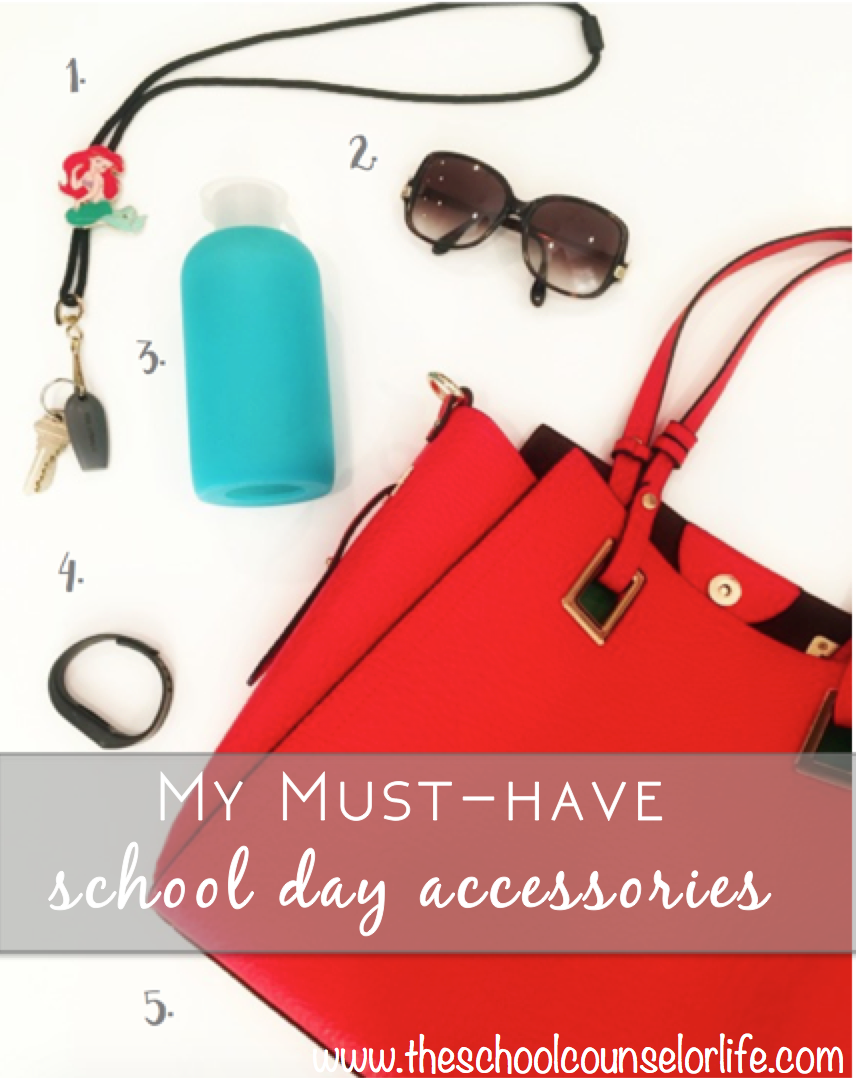
My Must-Have School Day Accessories

Screen Shot 2015-10-24 at 3.48.24 PM

  1. Lanyard – My work BFF, who is the School Librarian, gave me this Disney Princess lanyard, and I use it everyday at school {of course she has a matching one with Belle on it}. She was a cast member at Disney World for a year, and these lanyards are exclusive to Disney cast members {which gives us tons of “street cred” with the kiddos}. Since I am constantly in and out of my office, it is so handy to have my keys around my neck during the school day. I can lock my office so my case notes are properly protected without carrying my keys in my hands every time I leave the room.
  1. Sunglasses – My sunglasses are a must-have for the school day, especially on days I go out to recess to observe children. I also have carpool duty every day after school {oh, the joy}, so proper eyewear is crucial on sunny days. I found these Marc Jacobs sunglasses on ebay for about $30 {score!}
  1. BKR Water Bottle – A goal of mine this year is to drink more water throughout the day, as it seems I am perpetually de-hydrated. BKR Bottles are my favorite. They’re made of glass, can go in the dishwasher, and hold a decent amount of water {mine holds 16oz, but they have larger sizes}. Check it out here.
  1. FitBit – I absolutely love my FitBit! As someone who values being active, my FitBit helps me keep track of how much I am moving throughout the day. Some days I feel as if I am literally running laps around the school, while other days I know I spend a lot of time sitting at my desk or with a student. On my more sedentary days, my FitBit is a great reminder to get up and move, and if my step count is low, I will take a quick break to do a walk around of my school {which is also great to observe students in the classroom}.
  1. Bag – A large, sturdy bag is an essential work accessory for me. I personally love this bag from Wilson’s Leather because it has enough space for files and my laptop, which is great for days I need to bring a lot of work home with me. I found the bag pictured above at the Wilson’s Leather outlet for $35 {it also came with a crossbody bag inside of the large bag}, but they have it in white and black on their website right now for $65 {normally $160}. View here.

Screen Shot 2015-10-12 at 8.12.23 PM